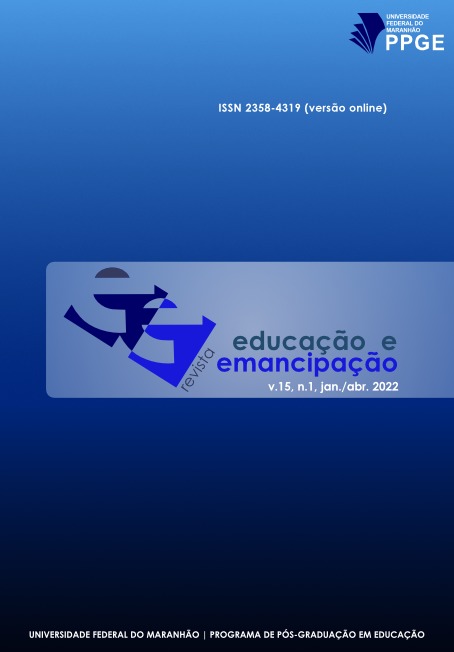
The absent body: educational research in pandemics times (2020-2021)
DOI:
https://doi.org/10.18764/2358-4319v15n1.2022.13Keywords:
corporeal identity, neurosciences, educational research, remote class, pandemicAbstract
This article aims to measure the educational production interested in discussing the impacts of the remote teaching model, considering the articles published over the period 2020 and 2021 in journals allocated in strata A1 and A2 of the Qualis-CAPES table. We start from the following hypothesis, put forward by Nikolas Rose and Francisco Ortega: in recent decades we have witnessed a change in paradigms in relation to our body, which, from a mere envelope of something greater – consciousness or soul – has been transmuted into a privileged sign of identity, generating an entire culture aimed at improving our bodily powers. As a result of this change, several discourses that take the body as an object, especially those linked to neuroscience, gained momentum, and impacted the field of pedagogical studies. We question, however, how much the quarantine policy and the adoption of a remote teaching model impacted the circulation of these discourses. Through an foucaltiane analysis of this articles who consider the current situation, it was possible to verify that the concern with the body disappeared, giving space to a discussion regarding the need to reframe the task of educating the new generations.
Downloads
Downloads
Published
How to Cite
Issue
Section
License

This work is licensed under a Creative Commons Attribution-NonCommercial-NoDerivatives 4.0 International License.
Declaração de Responsabilidade e Transferência de Direitos Autorais
Como condição para a submissão, os autores devem declarar a autoria do trabalho e concordar com o Termo de Transferência de Direitos Autorais, marcando a caixa de seleção após a leitura das cláusulas):
- Certifico que participei da elaboração deste trabalho;
- Não omitir qualquer ligação ou acordo de financiamento entre os autores e instituições ou empresas que possam ter interesses na publicação desse trabalho;
- Certifico que o texto é original isento de compilação, em parte ou na íntegra, de minha autoria ou de outro (os) autor (es);
- Certifico que o texto não foi enviado a outra revista (impressa ou eletrônica) e não o será enquanto estiver sendo analisado e com a possibilidade de sua publicação pela Revista Educação e Emancipação;
- Transfiro os direitos autorais do trabalho submetido à Revista Educação e Emancipação, comprometendo-me a não reproduzir o texto, total ou parcialmente, em qualquer meio de divulgação, impresso ou eletrônico, sem que a prévia autorização seja solicitada por escrito à Revista Educação e Emancipação e esta a conceda.
Este obra está licenciado com uma Licença Creative Commons Atribuição-NãoComercial-SemDerivações 4.0 Internacional.
 English
 Español (España)
 Français (Canada)
 Italiano
 Português (Brasil)